
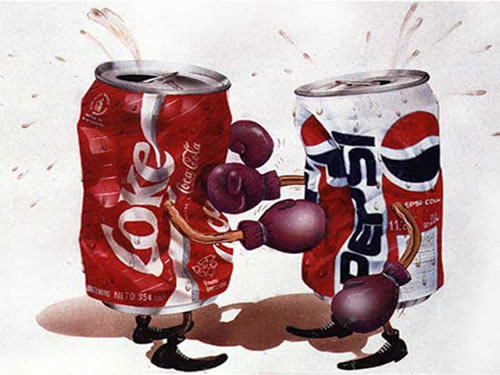
Would you like a shop where you can choose just between Coke and Pepsi?
Would you prefer more choices or fewer ?!? the intuitive answer is always one : MORE ! and , for the same reason , business owner run behind this idea offering several variations of a product trying to meet the expectations of different kind of customers..yet is there a threshold to the amount of choices or not?
A very famous experiment at Columbia university evaluated the effect of choice on a simple product : fruit jams .
They organized two different kind of selling : in one just 6 flavors , in the other 24 …4 times more .
Intuitively you expect that the larger assortment would attract more people and sell more product.
Yet data are counterintuitive .
The larger assortment attracted 50% more people but , the amount of buyers was scarce .Just 3% bought something .
The smaller assortment instead sold to 30% of potential customers . …10 times more !
Too many choices can create more indecision , friction ; the customer got lost pondering options, maybe he get away trying to decide thinking to come back later ..but often he doesn’t.
There is a threshold in the number of choices and in every field this changes.
For Jams is clear that 24 is worst than 6 but in dentistry ?!?
I see many colleagues following the golden rule to “inform “ the patient on his/her situation trying to explain advantages and disadvantages of every treatment plan …
We know that the amount of possible treatment plan in dentistry , especially in complex cases is wide…removable or fixed ? bone regeneration or short implants ? Connective tissue graft or just some composite on some recessions ? on and on …we can spend so much time describing pro and cons of each treatment …and , last but not least , do we wanna talk about the economical side of the treatment ?!? we can move from a cheap removable treatment to a complex and expensive rehabilitation .
In dentistry , moreover , i realized that the dentist and the patient play a sort of Killer game . The dentist starts to explain the different plans highlighting pro and cons , the patient has some problems understanding exactly the meaning of these pro and cons so he start placing some questions . But more questions lead to a bigger amount of other informations , other pro and cons.
Complexity raise , comprehension doesn’t.
In the Barry Schwartz book “ the paradox of choice “ this approach has been tested in the field of salesman . The result is that the information oriented approach increases the likelihood of refusal up to 50% .
Much more effective is instead the prescriptive approach where the patient/customer is guided toward a specific solution that has worked in a very similar situation
Using this approach the results are stunning , this increases the likeliness of purchasing ease by 82% and also drops the probability of buyer remorse by 37%.
It’s a win win scenario of managed in an ethic way .
The patient is driven in a comfortable way to a solution without the hassle to feel the weight of decisions in fields where he has zero expertise.
The dentist raise his acceptance ability but at a cost .
The weight of responsibility is shifted on us .
I started using this approach long ago , after reading books and testing different approaches with patients.
In my office I can guarantee that this approach works much better but we have to change completely our approach.
We have to learn how to interview the patient , we have to learn how to listen at the patient , we have to learn how to understand the person behind failing teeth or missing ones…and we have to accept the weight of being responsible for the choice .
Giving choices to people is easier …we don’t choose , they do .
Giving one solution , they don’t choose , we do …and we can do mistakes also , and we have no one to blame apart ourselves .
In the past I was not sure how to move between these two approaches , sometimes I was trying to combine them .
With time , yet , I realized that using the first approach most of the patients were deciding just on an emotional basis …some were accepting , by default , the most expensive treatment ( believing this was the best ) . Some , confused , afraid to make a mistake , were deciding the cheapest one or they were just saying the most hated words : Thank you doctor , i will decide in the next day and will let you know.
I realized that in this unbalanced relation we doctors have with patients using the first approach the number of mistakes was much higher .
The second approach was , eventually , more precise .
So I started removing PLAN a , PLAN b , PLAN c , I started trying getting really interested at the person in front of me and I started being easier and essential in my communication regarding dental details and spending more time on relational /behavioural /time needs and expectations.
And , again , I learned that everything in life is not absolute . Every thing we meet in our life has a correct measure …not too little , not too much .
Not enough choices is a problem like too many choices .
Not enough freedom is a problems like too much freedom , leading to what se wee nowadays in modern countries where the excess of freedom , paradoxically , has brought a sense of losing social and familiar connections and has created more loneliness and depression than ever.
Not doing mistakes is a problem like doing too many .
Everything has a balance .
Life can only be understood backwards , but it must be lived forwards.
P.s. if you’re still struggling deciding which prosthetic technique choose , I will solve your problem 🙂 Just have a look at my brand new “in person “ course in Syracuse about vertical prep!